
Chesapeake Bay Log Canoes
As an example of later stage development of log canoes, we have a half-hull model of a “Poquoson Log Canoe”. This model is based on lines developed by Howard I. Chapelle from a decommissioned boat found in Harry Hogan, Virginia in 1947. The vessel’s name was “Volunteer” and was 24-feet long, built in 1899. The boat could sport two masts with sails or reduce sails to one mast depending on the weather.
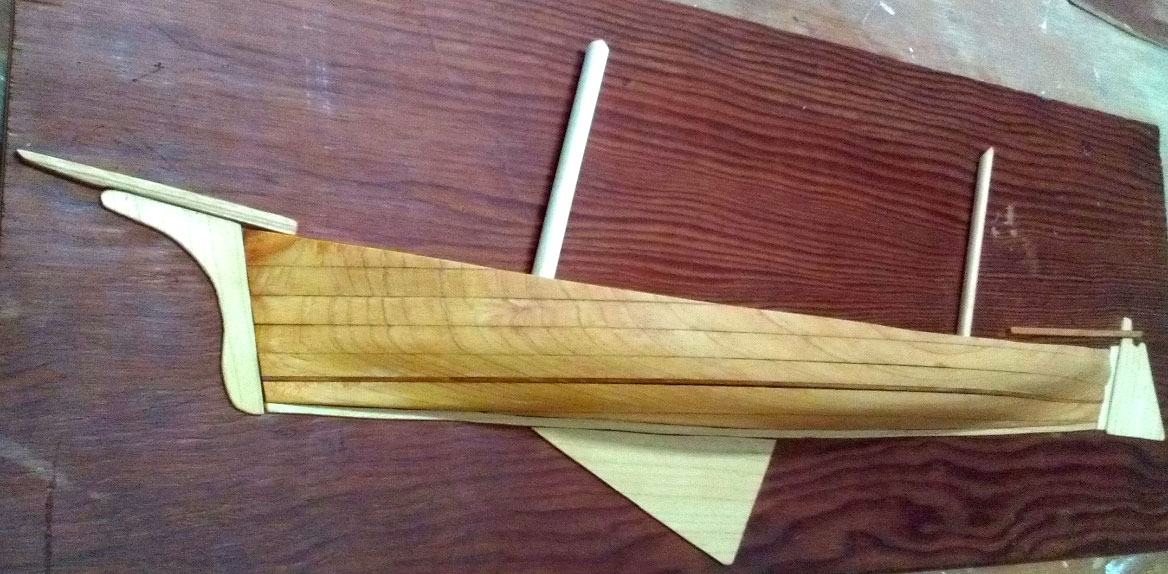
Half-hull model of “Volunteer” 1899 Poquoson Log Canoe
The term “log canoe” covers a wide range, from the charred and oyster shell-scraped troughs of the region’s first inhabitants to the overdeveloped and highly specialized racing machines of Maryland’s Eastern Shore. There is a long evolution of the boat type under the label of log canoe and we will not attempt to develop that here, instead we’ll give a few representations of those boats and, if available, some names, places and launch dates.
The number of dug-out log canoes created locally by the Indian nations is unknowable. We can say that dug-out type canoes were in use and under construction when the first Europeans arrived. These boats were documented by several sources. An occasional remnant of a dug-out could still be found in the back woods and waters. Early colonists reported the dug-outs as reaching 30 to 40-feet in length and capable of carrying 30 or more people. More typical canoes were smaller, but take note that a recent re-creation of a dugout from a 14-foot log came in at 300-lbs. It was found to be very stable but nothing easy to maneuver around on the beach! These canoes where the mainstay for the indigenous peoples in regards to transportation, fishing and warfare. A deep dive into indigenous canoe production would be a fascinating study.
The newly arrived colonists quickly discovered the need for small boats and equally quickly realized they did not have the skills or wherewithal to build them. Word was sent back to England for shipwrights but most who came did not survive the “seasoning” required to abide in the New World. The colonists soon adopted the native’s dug-outs and applied the advantage of steel-edged tools such as axes and adzes, which were much more efficient in cutting away all the parts of the log that were not the canoe.
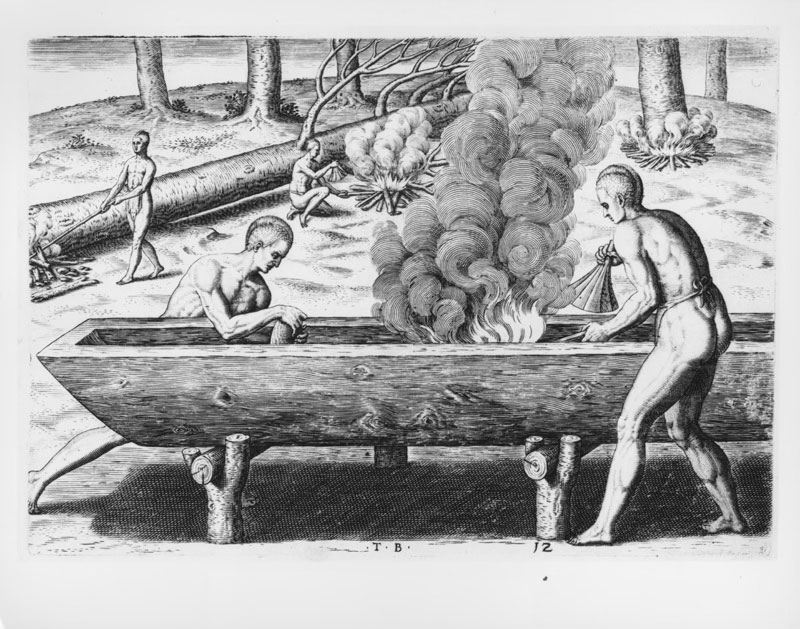
John White’s depiction of native canoe building circa 1590.
The introduction of enslaved laborers from regions of West Africa brought in new skill sets, mostly unrecognized, in the art of hand-hewn dugout canoes. These three influences, Native, African and European combined to create the log-built vessels still seen today.
It was often noted that the use of log construction was primarily due to the lack of available milled lumber, but the fact that production of log canoes continued all the way through the ship building era in Mathews and actually superseded it, suggests that log canoes gave good returned value on investment. They were almost indestructible and were usually easy to repair. It’s likely that log canoe production would have continued if not for the lack of suitable-sized trees.
The continual development of Chesapeake log canoes resulted in highly efficient and finely tuned water craft. This quote from a 20th century naval architect discusses the refinement:
A letter from Sidney A. Vincent, “eminent naval architect at Newport News Shipbuilding and Drydock Company” (1958)
“In 1925, when I arrived in Newport News, some of those in the hull design division of the shipyard suggested that I might like to see a log canoe at the boat harbor. I expected to see a log burned out by fire and crudely chopped into shape by Indians. Instead, I found what appeared to be an excellent hull form and I spent the weekend lifting the lines. The drawing was destroyed long ago but, and this is the point of my writing, I did analyze the lines plotting the sectional area curve and entrance load waterline. To my surprise these basic hull form factors checked almost exactly with the latest (1925) naval destroyer hull forms. I assume that as one log canoe after another was built, the faster ones gave guidance for those to follow. This is exactly what is done in the modern model basins where merchant and naval vessel lines are checked and developed. To me it is remarkable that non-technical oystermen years before scientists with 1925 model basin facilities came to practically the same answer for relatively high-speed craft”
Log canoes were the go-to work boat in Mathews County up into the 20th century when they were replaced by the plank-on-frame “deadrise” workboats common today. Mathews native Garland Miller recalled how they used their canoes for oystering in the winter and fishing in summer, with an occasional holiday race thrown in. Families would often take their canoes to church services and community events as the weather allowed. Below is a photo of Captain Johnny Miles’s log canoe in a 1937 race on the East River.
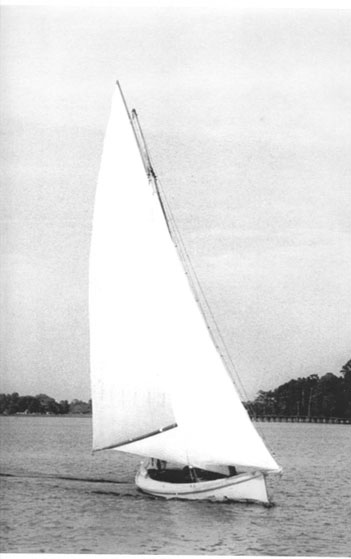
Photo provided by Gloucester Gazette Journal
Mathews native Garland Miller was well renowned for his modified Poquoson log canoe Tradition, which he raced extensively in the 1930s-1940s.
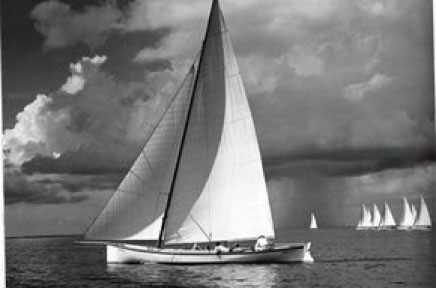
Garland Miller’s log canoe “Tradition” from Judge North’s book “Tradition, Speed and Grace: Chesapeake Bay Log Canoes”
Mike Moore
Deltaville, Virginia
September, 2026
References
Burgess, Robert, Chesapeake Sailing Craft Part I, Tidewater Publishers, Cambridge, MD 1975
Pg 3 Letter from Sidney A. Vincent, “eminent naval architect at Newport News Shipbuilding and Drydock Company” 1958
Moran, David Andrews, "The Technique of the Poquoson-Style Log Canoe" (2014). Dissertations, Theses, and Masters Projects. Paper 1539626751. William and Mary University
Brewington, M. V., Chesapeake Bay Log Canoes and Bugeyes, Cambridge, MD, Cornell Maritime Press, Inc. 1963
Edgar, E., “'Wasted Life’ of Sail Racing Leaves Skip with No Regrets” Ledger-Star, Norfolk, VA, Feb. 11, 1964
North, Judge, II, Tradition, Speed and Grace Chesapeake Bay Log Canoes, St. Michaels, MD, Chesapeake Bay Maritime Museum, 2018
Webb, Jane and George, The Best on The Bay, Christopher Newport College, VA, The Sailing Association Press, 1984
Wiley, Ralph, “Maryland vs. Virginia, the 1938 Log Canoe Championship”, Yachting Magazine, NY, August, 1938
Chapelle, Howard, Ships Plans Division, National Museum of American History, Washington, DC
Chowning, Larry, Harvesting the Chesapeake, Centreville, MD, Tidewater Publishers, 1990